

 sales2@super-metals.com
What Makes a Trusted Kanthal Wire Seller for Long-Term Industrial Supply?
For industrial heating applications, purchasing resistance wire is rarely a one-time decision. Furnace manufacturers, maintenance teams, heating-element producers and industrial plants often require the same material repeatedly over months or years. In these situations, the seller’s ability to support that ongoing relationship, including production capacity, logistics and communication, can matter just as much as the wire specification itself.
A trusted Kanthal wire seller should be able to demonstrate all of this directly, on request, rather than asking a buyer to take capacity and consistency on faith. This article looks specifically at what changes once a buyer moves from a single order to a long-term, recurring supply relationship.
Confirm the Alloy Grade Stays Consistent Order to Order
Before entering a repeat-order relationship, confirm exactly which alloy grade is being supplied, and ask the seller to state it explicitly on every order confirmation, not just the first one. The concern here is not identifying the grade itself; that is a one-time check. It is making sure nothing changes silently between the third order and the thirtieth.
Check Available Sizes and Forms
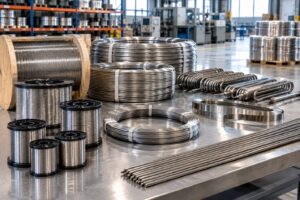
Industrial buyers do not all use the same wire diameter. Fine resistance wire may be required for smaller heaters, while industrial furnaces may use substantially heavier wire or alternative element forms.
Before entering a long-term supply relationship, check whether the seller can consistently provide the sizes required by your production programme. It may also be useful to ask whether the supplier offers:
- Different wire diameters
- Large and small spool sizes
- Straightened wire
- Resistance strip
- Pre-formed coils
- Custom-packed quantities
A broader manufacturing range reduces the need to source different heating materials from multiple suppliers as your product line grows.
Consider Production Capacity and Scalability
A supplier may perform well for a small trial order but struggle when demand increases. If your company expects regular or growing consumption, ask about manufacturing capacity and typical lead times at higher volumes, not just at the quantity of your first order.
For example, a heating-element manufacturer may initially order 50 kilograms of resistance wire per month but later require several times that volume as new furnace contracts come in. A seller sized for occasional orders may quote well on a small trial batch and still become a bottleneck once volume climbs. Ask directly what their maximum monthly output looks like, and whether that number has actually been tested by a customer.
Plan for Lead Times, Minimum Orders and Buffer Stock
Long-term supply arrangements benefit from planning beyond the next single purchase order. Ask whether the seller offers a standing or framework agreement that locks in pricing and priority production slots against a forecast volume, rather than negotiating every order from scratch.
It is also worth asking about minimum order quantities at each wire size you use, and whether the seller is willing to hold agreed buffer stock so an unexpected spike in your own production does not leave you waiting on a full production lead time. This matters more for recurring buyers than for one-off purchases, and it is a question worth asking before a shortage forces the conversation.
Packaging and Shipping for Repeat, Long-Distance Orders
Resistance wire can be damaged during poor handling or transportation, and the risk compounds over a long-term relationship involving many shipments rather than one. Spools should be packed in a way that reduces the risk of tangling, deformation, contamination or moisture exposure during storage and shipping.
For international orders, ask specifically how the seller packages against humidity and handling damage over longer transit times, and what export documentation accompanies each shipment. Clear, consistent labelling also matters more as order volume grows: each package should make it easy for warehouse and production teams to identify the alloy grade, diameter, quantity and batch information without opening it. For companies purchasing several wire sizes simultaneously, accurate labelling prevents costly material mix-ups on the production floor.
Assess Communication and Responsiveness
Industrial supply problems occasionally occur even with good planning. A shipment may be delayed, a specification may need to change, or an urgent replacement order may be required.
The supplier’s response in these situations reveals more about long-term reliability than the original quotation ever will. A strong long-term supplier should respond clearly to technical questions, confirm specifications before production, and communicate promptly and proactively if a delivery schedule changes. Ask a prospective seller how they have handled a real delay for an existing customer; a vague answer here is often a more useful signal than a polished quotation.
Conclusion
Choosing a reliable Kanthal wire seller for long-term supply is a different exercise from choosing one for a single order. Once the alloy and dimensions are confirmed, what determines whether the relationship holds up over years is production scalability, planning for lead times and buffer stock, packaging suited to repeat shipments, and how the supplier communicates when something goes wrong.
Buyers who evaluate these factors upfront, rather than only after the first shortage or delay, are better positioned to keep production running as their own volume and requirements grow.