

 sales2@super-metals.com
Kanthal Wire Factory China: How Industrial Heating Wire Is Manufactured
A spool of resistance wire looks like the simplest item in a heating-element workshop. It isn’t. Between the melting furnace and the finished spool, FeCrAl wire goes through a long chain of separate operations, and a slip at almost any of them shows up later as a hot spot, a cracked coil or an element that fails months ahead of schedule.
Buyers who search for Kanthal wire factory China usually want FeCrAl resistance wire that can do the same job as Kanthal® A1 or APM in their furnaces and heating elements. Kanthal® is a registered trademark of its owner, so what a Chinese mill actually produces is an FeCrAl alloy made to its own grade designation, typically under the Chinese standard GB/T 1234.
This post follows FeCrAl wire through a typical Chinese production line, stage by stage, and explains what each step actually does to the metal.
1. Melting the FeCrAl Charge
Everything starts with the charge: low-carbon iron, chromium and aluminium, weighed out to hit the target grade. For a common grade like 0Cr25Al5 that means roughly 23 to 26% chromium and 4.5 to 6.5% aluminium, with iron making up the balance.
The small additions matter more than their percentages suggest. Rare earth elements such as yttrium or cerium, and sometimes zirconium, help the protective aluminium oxide layer stay attached to the wire as an element heats up and cools down thousands of times. Leave them out and the oxide flakes off, fresh metal is exposed, and the wire burns through its aluminium reserve much faster.
Most mills melt in an induction furnace, often under vacuum or a protective gas, because molten aluminium reacts quickly with oxygen and nitrogen in air. Carbon and nitrogen are held low for a practical reason. Both form hard, brittle compounds that make the wire harder to draw and more likely to crack when it is coiled.
2. Refining and Casting the Ingot
Getting the chemistry right on paper is one thing. Getting clean metal is another. Many producers remelt the first ingot using electroslag remelting (ESR), where the metal drips through a pool of molten slag that captures oxide inclusions on the way down. What comes out is a denser ingot with far fewer non-metallic particles.
That matters more in wire than in almost any other product form. When the wire gets down to a few tenths of a millimetre, a single hard inclusion can snap it in the die, or survive into the finished coil as a weak point. Samples from each heat go through spectrometer analysis before the ingot moves on. If the aluminium comes in low at this stage, nothing downstream can put it back.
3. Hot Rolling to Wire Rod
The ingot is reheated, forged or rolled into billets, and then hot rolled into wire rod a few millimetres thick. FeCrAl is awkward to work at this stage. It is a ferritic alloy, its grains grow quickly at high temperature, and coarse-grained FeCrAl is brittle at room temperature. So the rolling schedule, and especially the finishing temperature, is kept inside a fairly narrow window to hold the grain structure fine.
Well-rolled rod bends without complaint. Rod that ran too hot tends to crack in the very first drawing pass, and the mill finds out quickly.
4. Descaling Before the First Draw
Hot rolling leaves a hard oxide scale on the rod surface. Feed that into a die and it chews up the die and scores the wire. The scale is removed by shot blasting, acid pickling or a combination of the two, followed by thorough rinsing. Some lines then apply a thin carrier coating so the drawing lubricant has something to grip.
It is an unglamorous step. It is also one where shortcuts show up as surface defects that follow the wire all the way down to its finest sizes.
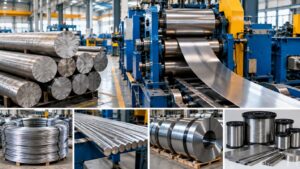
5. Drawing Down Through Carbide and Diamond Dies
Drawing pulls the rod through a series of dies, each slightly smaller than the one before. Heavier sizes usually run through tungsten carbide dies with a dry, soap-type lubricant. As the wire gets finer, the line switches to diamond dies and often to wet drawing, with the wire and dies running in a lubricant bath that keeps heat and friction under control.
Every pass work-hardens the metal, and FeCrAl hardens fast. It can only take so much total reduction before it has to be annealed, or it starts to split. For the same reason, the first passes on heavier rod are sometimes done warm rather than fully cold.
Diameter is the thing element designers care about most. Resistance per metre goes up as cross-sectional area goes down, so a wire drawn 2% under size in diameter carries about 4% more resistance per metre. On 0.3 mm wire, 2% is just six microns. That is why diameter is checked continuously at the die exit, with laser gauges on many modern lines, and why worn dies get replaced based on measurement rather than a fixed schedule.
6. Intermediate and Final Annealing
Between drawing stages the wire goes back into a furnace to recrystallise, which restores enough ductility for the next round of drawing. With FeCrAl this is a balancing act. Anneal too cool and the wire stays hard. Anneal too hot, or too long, and the grains grow, and coarse grains are exactly what makes this alloy brittle.
Fine wire is normally annealed continuously, running through a tube furnace under hydrogen or a nitrogen-hydrogen mix so the surface stays clean. Heavier sizes may be batch annealed instead. The last anneal sets the delivery condition: soft enough that the customer can wind tight coils without cracking, and without so much springback that the coil pitch drifts.
7. Bright or Oxidised: Finishing the Surface
After the final anneal, the wire gets its delivery surface. Bright annealed wire has a clean metallic finish. Oxidised wire is deliberately passed through an oxidising atmosphere to build a thin grey-to-dark oxide film.
The oxidised finish gives a little insulation between neighbouring turns during winding and a head start on the protective scale, which is why it is popular for elements resting on ceramic supports. Bright wire is often preferred where the element will be welded or crimped to terminals, since an oxide layer makes a clean joint harder to achieve.
Whichever finish is chosen, the surface is inspected for scratches, die marks, pits and leftover lubricant. A scratch that looks harmless on the spool can become the spot where the oxide layer first breaks down once the element is in service.
8. Testing Resistance, Coiling Behaviour and Life
Resistance per metre is measured on every coil and compared against the nominal figure for that grade and diameter. Because this single number reflects both chemistry and diameter at once, it is the most useful routine check a mill has.
Mechanical tests come next: tensile strength and elongation, plus a wrap test where the wire is wound tightly around a mandrel, often one equal to its own diameter, and examined for cracks. It is a close stand-in for what the customer’s coiling machine will put the wire through.
When qualifying a grade or checking a new heat, mills also run accelerated life tests. A sample is switched on and off at high temperature until it burns out, following methods such as ASTM B78 or the Chinese equivalent. The hours to failure show how well the chemistry and rare earth additions are protecting the wire, which is something a chemistry certificate on its own cannot show.
9. Spooling for the Customer’s Winding Line
Finished wire is wound onto spools or into coils sized to its diameter, with fine wire on small spools and heavier wire in coils or large reels. Winding tension deserves more attention than it usually gets. Wind too tight and the wire takes a set that fights the customer’s coiling machine. Wind too loose and the layers cross over and tangle when the wire is paid off.
Each spool is labelled with grade, diameter, heat number and measured resistance, then sealed against moisture for sea freight. The heat number is what ties a spool back to its melt record and test results if a question ever comes up later.
Conclusion
None of these steps is exotic on its own. What separates dependable resistance wire from ordinary wire is how tightly each stage is controlled: aluminium content in the melt, finishing temperature on the rolling mill, die wear, annealing temperature and a resistance reading on every coil.
If you are comparing suppliers for FeCrAl heating wire, asking how these stages are handled will tell you far more than a datasheet. And if you would like to know how a specific grade is produced for your application, the Heanjia Super Metal team is happy to walk you through it.