

 sales2@super-metals.com
Kanthal Coil Supplier China: How to Choose the Right Coil for Your Furnace
Heating coils are central to the performance of many electric furnaces. Their resistance, wire diameter, coil diameter, pitch and surface loading influence how effectively electrical energy is converted into heat.
This article looks at a common and specific situation: a furnace operator needs to replace an existing coil, is sourcing that replacement from a Chinese supplier, and needs a way to verify that what arrives will actually match what is being replaced. When evaluating a Kanthal coil supplier China, industrial buyers should focus on documentation and verification. Kanthal® is a registered trademark, so Chinese-manufactured FeCrAl coils should not automatically be assumed to be genuine Kanthal® products unless their origin is clearly documented.
Start From the Failed Coil, Not a Description
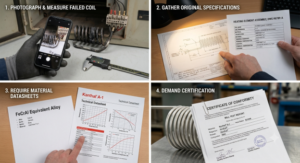
When a coil fails, the most reliable starting point for a replacement is the coil itself, not a verbal description of it. Photograph the coil before removal, including the terminal ends and any identifying marks, and measure what can still be measured accurately: overall length, coil outside diameter, approximate wire diameter and terminal configuration.
If the original coil came with a drawing or purchase specification, locate it before requesting quotations. A supplier working from a drawing and photographs can reproduce a coil far more reliably than one working from a description such as “similar to what we had before.”
Verify the Alloy Identity, Not Just the Description
A quotation describing a coil as “Kanthal-type” or “FeCrAl equivalent” does not confirm what alloy is actually being supplied. If a supplier offers a Chinese FeCrAl equivalent rather than genuine Kanthal® material, request that material’s own technical datasheet rather than assuming it matches Kanthal’s published data.
Ask specifically whether the supplier can provide a certificate of conformity or mill test report tying the coil to a specific alloy batch. For a replacement part that needs to match existing equipment, this documentation matters more than a verbal assurance that the material is equivalent.
Provide Furnace Operating Data Alongside the Old Coil
Photographs and measurements of the failed coil establish geometry, but a supplier still needs to know how the coil will operate: supply voltage, required power, furnace atmosphere, and how the coil is supported in the furnace.
Provide this alongside the physical reference rather than relying on the old coil’s dimensions alone. A coil that matches the original geometry but was designed for a different atmosphere or duty cycle may not perform the same way once installed.
Approve a Sample Against the Original, Not Against a New Drawing
For a new supplier, request a single sample coil before committing to a batch, and check it directly against the original: does it fit in the same installation space, does its terminal arrangement match, and does its measured resistance fall within an acceptable range of the original’s rated resistance?
This comparison is a more reliable check for a replacement part than approving a sample purely against a new specification sheet, since the goal is matching known-working equipment rather than validating a new design from first principles.
Document the Approved Sample as the New Reference
Once a sample coil is approved, keep the approved unit, its measurements and its supplier documentation on file as the reference for all future reorders, not just the original specification. This becomes especially useful if the original equipment’s own documentation is incomplete or was never kept in the first place, which is common with furnaces that have been in service for many years.
Conclusion
Sourcing a replacement heating coil from a Chinese supplier is fundamentally a verification exercise: matching a known-working part, confirming what alloy is actually being supplied, and documenting the result so the next reorder does not start from zero again.
Buyers who lead with the failed coil itself, rather than a description of it, generally get a more accurate replacement than those who rely on a supplier’s standard catalogue offering.