

 sales2@super-metals.com
Custom Kanthal and FeCrAl Heating Coils: What Specifications Can Manufacturers Customize?
Verifying alloy grade, wire diameter, resistivity and batch documentation on a quotation is covered in detail in our wire-specification checklist. Ordering a non-standard coil raises a separate set of questions that a wire datasheet does not answer at all: once the right material is chosen, how should the Kanthal coil or an equivalent FeCrAl heating coil actually be shaped and sized to fit the furnace it is replacing or being designed for? This article focuses specifically on the coil-geometry decisions a manufacturer needs from the buyer before a custom order can be produced.
Coil Diameter Is Fixed by the Installation, Not the Wire Alone
The outside diameter of the finished spiral has to match the ceramic supports, grooves or mounting hardware already inside the furnace, which means it is normally dictated by the installation rather than chosen freely. At the same time, it needs to suit the wire diameter being used: Kanthal’s design guidance treats the ratio between coil diameter and wire diameter as an important factor, since a coil wound too tightly places excess strain on the wire, while an oversized diameter relative to the wire produces a mechanically weak spiral.
For a replacement coil, the single most useful piece of information a buyer can supply is the existing support or groove dimensions, rather than an assumed coil diameter carried over from a previous invoice.
Pitch Sets How the Heating Surface Is Distributed
Pitch, the spacing between adjacent turns, determines how the element’s heat output is spread along its length and how much stretched wire length is needed to fill a given winding length. Kanthal’s design examples calculate pitch after wire length and coil dimensions have already been set, rather than choosing it first.
A tightly pitched coil concentrates heating surface into a shorter installed length, which can suit a compact chamber but increases the risk of adjacent turns touching if the coil sags in service. A more open pitch spreads the same heating length over a longer run and is generally more tolerant of minor sagging over the element’s life.
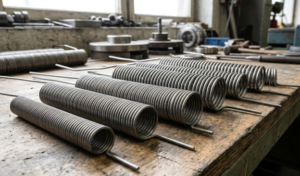
Overall Length Has to Account for Supports, Not Just the Winding
The wound length, the stretched operating length and the length actually needed to reach between furnace supports are three different figures, and a custom order should state which one is being specified. Kanthal’s heating-element design guidance treats wire length and coil dimensions as connected variables precisely because changing one without recalculating the others changes the resulting resistance.
For a like-for-like replacement, supplying the original element’s installed length, including any straight sections running to the terminals, avoids a coil that is electrically correct but physically too short or too long to fit.
Terminal Configuration Is Where Custom Coils Most Often Go Wrong
The transition from the heated coil section to the terminal connection is a common point of mismatch on custom orders, because it depends on the specific furnace’s electrical entry point rather than on any general design rule. Kanthal’s metallic heating-element range includes a number of different terminal arrangements rather than a single standard approach.
Supplying an engineering drawing, or an undamaged sample of the original element’s cold end, generally produces a more accurate match than describing the terminal in words. Where neither is available, specifying the terminal length and the connection type needed at the furnace end is the minimum information a manufacturer can reasonably work from.
Element Shape Beyond the Standard Spiral
A coiled spiral is only one configuration among several that Kanthal lists as available to customer specification, alongside edge-wound, meander and other metallic element shapes. The right choice depends on the available installation space, how the element is supported, and how heat needs to be distributed across the chamber, rather than on which shape happens to be the most common.
A meander or suspended element, for example, can suit a chamber where a spiral’s support points would be impractical, even when the underlying alloy and wire diameter are unchanged from a spiral design.
What to Send When Requesting a Custom Coil
Once alloy grade and wire diameter have already been confirmed separately, a custom coil enquiry is mainly a geometry and fit question. Useful information to provide includes:
- Coil inside or outside diameter required
- Pitch, or the overall winding length available
- Installed length, measured from terminal to terminal
- Terminal type and transition length
- Element shape (spiral, meander, edge-wound or other)
- A drawing or sample of the element being replaced, where available
Conclusion
Choosing the right alloy and wire diameter is only the first part of ordering a custom heating coil. Coil diameter, pitch, overall length, terminal configuration and element shape are geometry decisions tied to a specific furnace’s supports and electrical connections, and a manufacturer generally cannot resolve them from a material specification alone. Supplying installation dimensions and, where possible, a drawing or sample of the original element gives a custom-coil order the best chance of fitting correctly the first time.