

 sales2@super-metals.com
Kanthal Heating Element Design: Wire Size, Resistance and Power Explained
Designing a resistance heating element for an industrial furnace involves more than selecting a high-temperature wire and winding it into a coil. Wire diameter, electrical resistance, supply voltage, power requirement and coil geometry all interact, and the calculation for a single element is covered in detail in our resistance-calculation guidance. When working with a Kanthal heating element supplier on a circuit with more than one element, buyers should provide the full circuit arrangement, not just a single-element power target.
This article focuses on what changes once a furnace has more than one heating circuit: multiple elements sharing a zone, or a three-phase supply, since the numbers involved are not simply the single-element case repeated.
Series and Parallel Change the Per-Element Target
When two or more identical elements share a circuit, how they are connected changes the resistance each individual element needs.
As an illustrative example, suppose a zone needs a combined 6,000 W at 230 V, split evenly across two identical elements. If the elements are wired in series, each carries the same current and shares the voltage, and the required resistance per element works out to roughly 4.4 ohms. If the same two elements are wired in parallel across the full 230 V instead, each element only needs to produce half the total power at the full supply voltage, which works out to a considerably higher resistance per element, roughly 17.6 ohms.
The point is not the exact figures, which will vary furnace to furnace, but that connection type changes the target resistance for each element by a large margin, even though the total power delivered to the zone is identical.
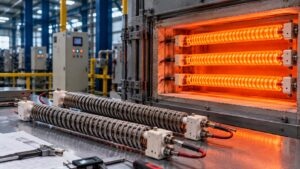
Three-Phase Furnaces Add Star and Delta Configurations
Three-phase furnaces introduce a further variable. In a star (wye) connection, each element sees the phase voltage, which is the line voltage divided by approximately 1.73. In a delta connection, each element sees the full line voltage directly.
As an illustrative example, for a furnace supplied at 400 V three-phase with three identical elements sharing 9,000 W evenly, a star connection puts roughly 231 V across each element, while a delta connection puts the full 400 V across each element. Calculating the required resistance from the wrong configuration produces an element sized for a different voltage than the one it will actually see, which is a common source of underperforming replacement elements.
The circuit configuration should therefore be confirmed before any wire-length calculation begins, not assumed from the furnace’s rated supply voltage alone.
Balancing Resistance Across Elements in the Same Zone
Where several elements share a zone, a resistance mismatch between them changes how current and heat are distributed across the group, even if the total zone resistance measures correctly. One element with noticeably lower resistance than its neighbours will tend to draw more current and run hotter than the rest.
For this reason, elements intended to operate together should be measured individually before installation, not only checked as a combined group. A zone that measures correctly in total can still contain one element that is out of tolerance and quietly running hot.
A Sample from a Multi-Element Circuit Needs Extra Care
Sending a single failed element from a multi-element zone to a manufacturer for an identical replacement carries an added risk beyond the usual concern that a used sample has already stretched, oxidised or deformed in service: its resistance may reflect its specific position in the original circuit, not the value the other elements in the zone are running at. Where possible, measure the remaining working elements in the same zone as a reference, rather than relying on the failed one alone.
Conclusion
A single-element resistance calculation is only the starting point once a furnace involves more than one heating circuit. Series and parallel wiring change the resistance target for each element, three-phase star and delta connections change the voltage each element actually sees, and elements sharing a zone need to be checked individually rather than only as a group.
Confirming the circuit configuration before calculating wire length prevents a common and avoidable source of underperforming replacement elements.